Its a myth that interior designers only work in huge spaces. Many of my clients have everyday homes and the same everyday space problems as the rest of us.
In my experience, small spaces can actually become the most efficient and inviting spaces in the home. It’s really all about tricking the eye and making the most of what you have with these clever designer tips.
Vertical Storage
When you’re lacking floor space, look upwards! Maximizing your vertical space just makes practical sense.
Add shelves high above your front door for seasonal hats and umbrellas, install a rack system above your sink for shelves, rails and hooks, and lift your paperwork off the desk with a giant pin-board or efficient rack system.
When space is tight, hooks are your friend. Add hooks to under-stairs cupboards, tiny spaces of empty walls and the back of larder doors. From hooks you can hang baskets to divide cleaning products, string up the broom or use as a handy dedicated spot to hang up your handbag when you enter the door
Make everything Multipurpose
In a smaller space, every item of furniture has to work extra hard. With clever planning and inspiration, desks can flip down to become a breakfast table, or perhaps a wide flat pack toy bench can double up as a console with artwork and plants on top, as well as toy storage in baskets.
Turn a dining bench into shoe storage, or make a drawer become a hidden charging station. The key is to look at what the room needs to accommodate, and tuck extra storage in every nook.
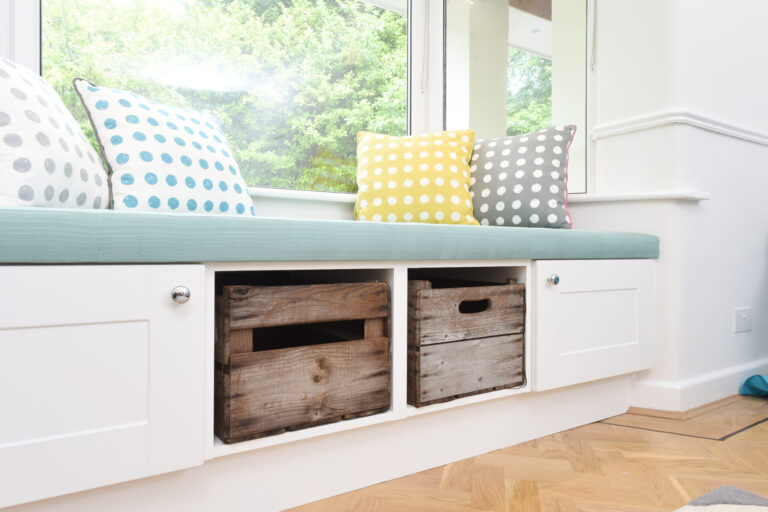
I used simple self-assembly pieces and vintage crates to create this chariming playroom window seat-toy storage unit in my client’s home in Didsbury. See this full project
Dark Colours in a Small Space = Big Impact
Its true that dark colours can close make some spaces shrink, but in fact when used boldly on many surfaces and in the right way, it can give a small space a real identity, Making it feel and look more inviting.
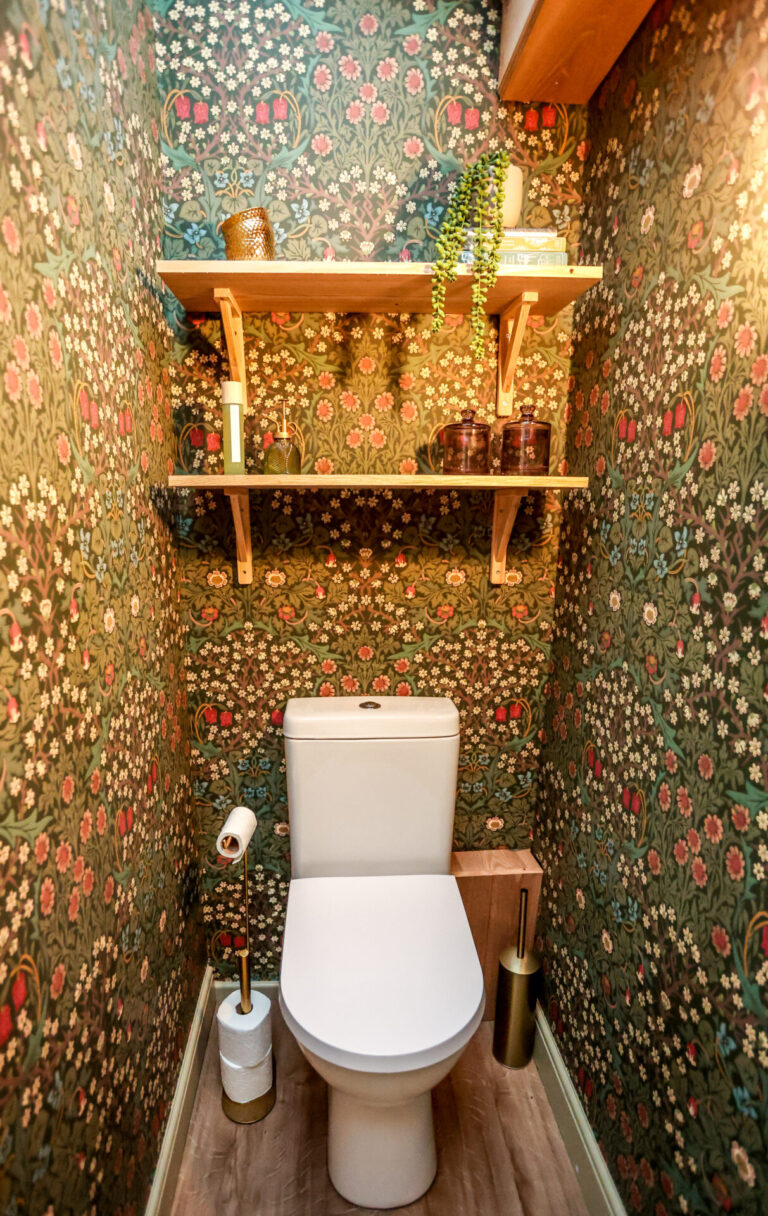
Try adding dramatic dark wallpaper to your tiny under-stairs washroom, and see how the white suite will pop. Or be brave and paint your box room ceiling in a rich, warm dark tone to introduce that cozy feeling.
For my client’s powder room in Manchester, I featured this stunning William Morris inspired paper over every wall for huge impact.
Go bold in your powder room for an unexpected surprise
Make the most of a bay window using simple furniture and clever styling
Embrace Odd Angles
If your small space is in your attic or features odd, seemingly unhelpful angles, its important to embrace them instead of trying to hide them. Nobody wants to live in a boring square box, and angles, beams and nooks add character and interest to a room.
Try highlighting angles with a splash of accent colour to overemphasis this quirk. Or wash an odd beam or pillar with uplight to showcase it. For bedrooms, opt for fitted furniture to maximize the space even in awkward angles like this one.
Space-enhancing furniture
When shopping for furniture pieces for your small space, its not just the physical size of which to take note. The overall style, shape and material are important design factors to consider too.
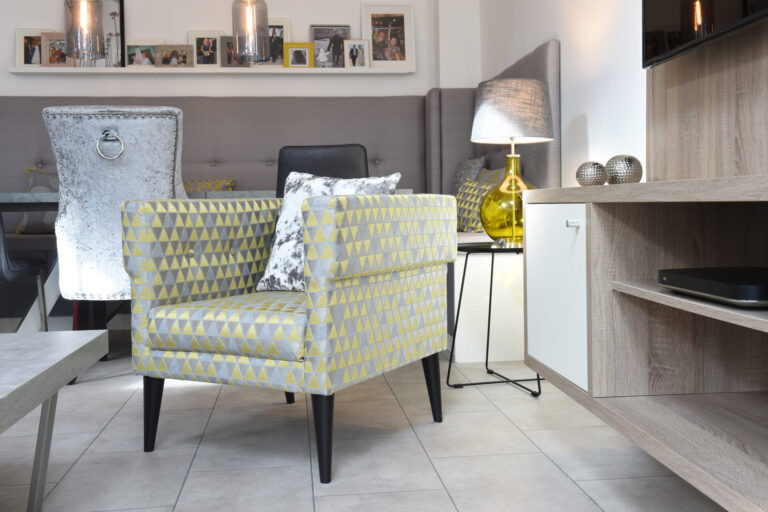
To help space flow around the room, look for coffee tables which are round with no jarring corners. Sofas or chairs which stand off the floor on legs allow the floor to be seen underneath, giving the illusion of more space. Light-reflecting materials such as white marble, gloss or mirror also help the interior to feel brighter and fresher, whilst the eye will see through clear glass pieces, reducing the impact of the item in the smaller space.
Opting for built-in furniture which enhances the angles and quirks of a room gives character and interest – who wants a boring square space anyway!
Bespoke wardrobes are ideal for awkward angles
Play with Scale
Having a smaller space doesn’t mean opting for tiny, poky items – in fact that can have a detrimental effect on the room. Instead, play with scale and add in some unexpected large items which add impact and interest.
Oversized leaning mirrors are ideal behind a sofa or console table, often giving the effect of room beyond the wall. Always choose a rug larger than you think to avoid a postage stamp size rug which only appears to shrink sitting rooms. Hang your curtains that little bit higher than standard – to the ceiling if you can to give the illusion of taller windows and more space, and sofas with low backs help even small rooms to feel tall.
The Power of Stripes
Simply adding stripes or lines to a room can visually alter how we see a space. For example, laying plank flooring in a diagonal direction can help to visually widen a narrow hallway as the eye is drawn to the furthest corners.
In a small bedroom perhaps, take tall bold stripes up the entire wall -and even onto the ceiling if you are feeling creative – to add drama and change the focus of the room.
To further elongate your walls, ditch the classic white skirting and paint to match your walls. That band of white which cuts off the wall (making it appear short) will disappear and your walls will visually stretch.
This compact childrens’ bedroom in Manchester was full of small-space interior design tricks
Vertical stripes elongate small spaces
HANNAH’S TOP 3 TIPS FOR PLANNING SMALL SPACES
Planning a new layout for your small room can be done in many ways so find what works for you best. Measuring the space and drawing it to scale, then cutting out movable pieces of furniture to find the best layout is one of the most accurate methods I often use myself. Others like to use online computer space planning tools, and some even like to cut giant cardboard piece sof their new furniture and physically move it around the empty room in situ.
Small rooms in particular can throw up detail issues which are easy to miss, so take extra care around radiators – ensuring doors and drawers can open without hitting them. Leave space to reach the window and curtains and allow for the door to the room to open fully against the wall.
It’s sound obvious, but don’t overfill your small space. Taking your time to add well-chosen pieces one by one is often the best way to ensure the room still feels open and welcoming, and over cluttering is a fast way to feeling closed in.
Want to view one of my smallest projects to date in all it’s detail?